Roku RSG 2.0: what TypeScript on Roku means for your streaming roadmap
Roku is opening its platform to TypeScript. Here is what RSG 2.0 changes, what it leaves alone, and how to plan around a beta that cannot yet ship to the Store.

By Vijaykishan Shyamsundar, Senior Director, Engineering
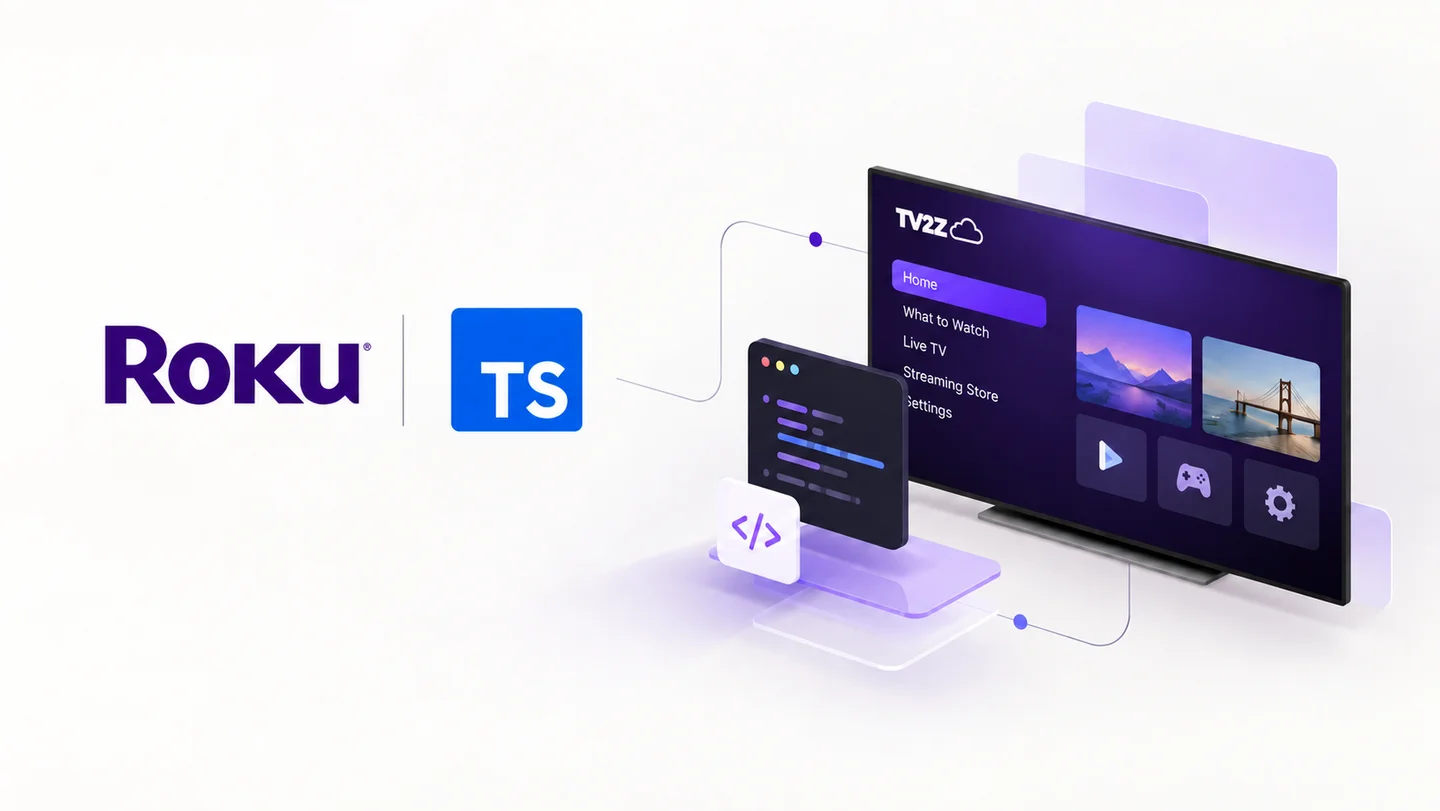
For as long as Roku has had a developer platform, building for it has meant BrightScript, a language used nowhere else. At its tenth Developer Summit on 23 September 2026, Roku announced that this is about to change: the RSG 2.0 SDK lets teams build Roku apps in TypeScript, and a public beta opens on 29 October.
For anyone who owns a streaming roadmap, this is the largest change to how Roku apps are built since SceneGraph was introduced in 2015. It is also easy to over-read. The announcement changes the language and the tooling. It does not change the device, the rendering engine, or, for now, the route to production.
This article is based on what Roku has published rather than on hands-on evaluation, because the SDK is not publicly available until the beta opens.
What Roku announced
The RSG 2.0 SDK brings SceneGraph, the framework behind Roku's user interfaces, to TypeScript. It is free and open source under the MIT licence. According to Roku's FAQ, it includes:
- SceneGraph in TypeScript - the full UI model, fully typed.
- SolidJS integration - reactive, component-based interfaces in a style most front-end engineers already know.
- FlexGrid - a virtualised grid engine for content shelves and grids.
- Focus management - a new system for layouts navigated by remote control.
- AI-assisted development - context and tooling so that coding assistants understand the SDK.
Applications run on Hermes, the open-source JavaScript engine originally built by Meta for React Native. Hermes also executes plain JavaScript, but Roku strongly recommends writing in TypeScript only, says it may make that a requirement, and is working towards compiling TypeScript directly to native executables.
What does not change
Three things stay as they are, and each one matters for planning.
BrightScript remains fully supported. Roku states plainly that RSG 2.0 does not replace it. Existing apps keep working, and TypeScript and BrightScript can run side by side in the same app, so a port can proceed one screen at a time.
The rendering engine is the same. As a Roku engineer put it on the developer forum, RSG 2.0 "doesn't change the underlying rendering mechanism of the devices, just what language can drive it." Roku devices still have no browser engine, no HTML, and no CSS. A web application cannot be moved across. Its business logic, data layer, and types can be shared, but the interface has to be built against SceneGraph components.
Certification stays broadly the same. Roku expects the requirements for RSG 2.0 apps to match those for BrightScript apps today, while noting that some SDK-specific changes may follow during the beta.
The timeline that matters
- 29 October 2026 - the public beta opens. The SDK, documentation, and samples become available on GitLab. Apps built with it can only be installed by sideloading.
- During the beta - there is no self-serve publishing to the Roku Streaming Store (formerly the Channel Store). A production release in this period requires explicit approval and direct support from Roku.
- 2027, expected - Store publishing opens, which Roku says will mark the end of the beta. It depends on infrastructure Roku is still building: server-side compilation, bytecode versioning, analytics dashboards with stack traces, and static analysis rules.
The practical consequence is simple. An app that must reach viewers through the Store before publishing opens still has to be built in BrightScript, unless Roku agrees to support the launch directly.
Two questions that bear on any plan also remain open. Roku has not yet published which devices and OS versions will run RSG 2.0 apps, or how those apps perform on older hardware.
Roku is changing more than the language
The SDK arrived alongside two other shifts. Roku will accept contributions to both the SDK and its documentation, and is moving its public repositories from GitHub to GitLab. It also announced the Roku Cloud Emulator, which provides virtual players and TVs in the cloud, controlled through a browser or a REST API, so that apps can be tested in automated pipelines without physical devices.
Taken together, these moves bring Roku into line with the rest of the TV industry. Amazon's Vega OS for Fire TV uses React Native for app development. Samsung Tizen and LG webOS are web platforms. The Lightning framework used on operator set-top boxes can already be programmed with SolidJS, the same library Roku has now chosen. TypeScript is becoming the common language of TV application development.
The renderers, however, remain different on every platform. What improves is the share of logic, skills, and tooling a team can carry from one platform to the next. A single interface codebase for every screen is still not on offer.
What this means for your roadmap
If you have a Roku app in market, nothing is required of you. There is no deprecation and no deadline. Continue to maintain and release it as planned.
If you are commissioning a new Roku app, BrightScript is still the production path for any launch ahead of Store publishing. Ask for the business logic to be kept separate from the interface, so that a later move to TypeScript is contained.
If you run apps on several TV platforms, plan an evaluation once the beta opens. Because the two languages coexist, a pilot can be a single screen rather than a rewrite. Its purpose is to measure performance on the oldest devices you support and to establish how much logic can genuinely be shared.
For budgets and staffing, expect the pool of engineers who can work on Roku to widen over time. Roku expertise does not become optional: SceneGraph, remote-first navigation, constrained hardware, certification, and Roku Pay all remain specific to the platform.
TV2Z delivers Roku apps alongside applications for Smart TVs, mobile, web, and operator set-top boxes. Those Roku apps are built with BrightScript and SceneGraph, which remains the production path until Roku opens Store publishing for RSG 2.0. If you are weighing how Roku fits into a multi-device plan, we are glad to talk it through.