In-app purchases and billing for streaming apps, store by store and country by country
App store billing for streaming services: what each store requires and charges on phones and TVs, how the rules differ by country, and when to sell direct.

By Noble George, Senior Product Manager
Every app store that carries a streaming app also wants a say in how its subscriptions are sold. Apple, Google, Roku and Amazon each run their own checkout, take their own commission and set their own rules about what an app may say about paying anywhere else. Over the last few years, and much faster since 2025, those rules have started to differ from one country to the next.
Court rulings in the United States, new laws and regulators in the EU, Japan, South Korea and Brazil, and new fee structures from Apple and Google have changed what an in-app subscription costs and where else a viewer may pay for it. The UK and Australia are next. Most of these changes reach phones first. On the TV, the platforms still largely set their own terms.
This article covers in-app purchases and billing on each kind of screen: what each store requires, takes and gives back, how the rules differ by country, how TVs handle payment, and what changes when a service sells direct. It ends with how to keep one subscription working on every screen, and what is about to change. Rules and rates are as of early November 2026.
Every screen has its own checkout
On phones and tablets, the two stores each run their own billing system: Apple's In-App Purchase on iPhone and iPad, and Google Play Billing on Android. On TVs the picture is more varied:
- Roku requires Roku Pay for any app with subscriptions or rentals, and both sign-up and sign-in have to happen on the TV.
- Fire TV requires Amazon's In-App Purchasing for digital content, and apps may not direct customers to other ways to pay.
- Google TV and Android TV use Google Play Billing. Only in the EEA do Google's other billing options and links reach TV apps.
- Apple TV uses Apple's In-App Purchase. Only in the EU do Apple's alternative payment terms cover it.
- Samsung offers Samsung Checkout in about 120 countries. Its public guidelines do not make it mandatory.
- LG no longer runs its own in-app billing and points developers to Paymentwall.
Then there is the web, where the service runs its own checkout through a payment provider, and the operator's own devices, where the operator decides.
On most platforms, a viewer who already pays elsewhere can simply sign in. That is what lets a service run an app that sells nothing at all and leave every purchase to its website. Netflix stopped new in-app sign-ups on iOS in 2018, and in 2024 began moving some of its remaining App Store-billed members to direct payment. Roku is the exception: an app with subscriptions has to offer Roku Pay, and sign-in has to happen on the TV.
The map below shows which ways to pay each platform allows. Choose a platform, and for phones, Apple TV and Google TV a region, to see how the rules change. The country section further down explains each one.

Where the viewer can pay
Choose a platform
Region
United States
- The store's billing
- Allowed
In-App Purchase: 30% in a subscriber's first year, then 15%. 15% from the start in the Video Partner Program.
- Your own billing in the app
- Not allowed
Apple's US rules allow buttons and links to other ways to pay, not other payment processing inside the app.
- A link or QR code to pay on the web
- Allowed
Buttons and links to the web are allowed, with no Apple commission for now. A court is deciding what Apple may charge; Apple has proposed up to 15%.
- Signing in with a subscription bought elsewhere
- Allowed
Allowed. An app can also offer sign-in only, with nothing to buy inside it.
Building and certifying an app for each platform means building its billing as well: every store has its own product catalogue, its own purchase flow and its own review rules for anything that mentions price.
What the stores take, and what they give back
Outside the countries with their own terms, the headline commission on subscriptions sits between 15 and 30 percent:
- Apple takes 30% in a subscriber's first year and 15% after a year of paid service. Developers earning up to US$1 million a year pay 15% from the start through the Small Business Program. Premium video services can join the Video Partner Program, which also charges 15% from the first day in the countries where it runs, if the app is on both iPhone and Apple TV, integrates with the Apple TV app, search and Siri, supports AirPlay, and offers In-App Purchase.
- Google charges 15% on subscriptions from the start. In its new fee structure, that is a 10% service fee plus a 5% fee for using Google Play Billing, in the US, the EEA and the UK since 30 June 2026 and in Japan and Australia since 30 September 2026. The structure reaches South Korea on 31 December 2026 and the rest of the world by 30 September 2027. So far, Google has published its 5% billing fee only for the US, the EEA, the UK, Japan and Australia.
- Roku keeps 20% of net revenue.
- Amazon pays 80% of the list price on movie and TV in-app products sold in apps on Fire TV and Fire tablets.
- Samsung sets its rates in partner agreements and does not publish them.
Commission is only half the comparison. In most countries the store sells to the viewer in its own name: under EU VAT rules an app store taking part in an electronic sale is treated as the seller, the UK has a similar rule, and Japan, South Korea and Australia apply one to foreign suppliers. So the store collects and pays the tax, and handles card payments, local payment methods, fraud, refunds and much of the customer service. Selling direct means taking that on, as the section on selling direct explains.
Card fees are the smallest part of that, but they vary by country. Stripe's standard rate for domestic cards is 1.5% plus €0.25 in the EU, 1.5% plus 20p in the UK, 2.9% plus 30 cents in the US, 3.6% in Japan and 3.99% plus R$0.39 in Brazil. Foreign and premium cards cost more, and Stripe Billing adds 0.7% of billing volume.
The calculator below puts these numbers side by side for a country, a price in its currency and a number of subscribers.

What you keep from each subscription
Country or region
European Union. Apple's EU terms since 1 October 2026: 20% for another payment provider in the app and 15% on links, each 10% at the reduced rate, which Video Partner Program members get from the start. Google charges 10% on both.
Subscriber
Subscribers
Where the viewer pays
You keep
 App Store, In-App Purchase
The standard rate.
Commission 26%
€7.40a month
€888,000 a year
€264,000 less than the web
- App Store, Video Partner Program
For eligible premium video apps on iOS and tvOS, through In-App Purchase.
Commission 15%
€8.50a month
€1,020,000 a year
€132,000 less than the web
- iPhone app, another payment provider
Only where a country requires Apple to allow it. Card fees apply.
Commission 20%Card fee €0.40
€7.60a month
€912,000 a year
€240,000 less than the web
- iPhone app, link to the web
Card fees apply. Where only the reader-app link is allowed, the app cannot also sell in-app.
Commission 15%Card fee €0.40
€8.10a month
€972,000 a year
€180,000 less than the web
 Google Play Billing
15% on subscriptions; in Google's new structure, a 10% service fee plus 5% for Play Billing.
Commission 15%
€8.50a month
€1,020,000 a year
€132,000 less than the web
 Android app, your own billing
Phones and tablets, and in the EEA TV apps too. Card fees apply.
Commission 10%Card fee €0.40
€8.60a month
€1,032,000 a year
€120,000 less than the web
- Android app, link to the web
Phones and tablets, and in the EEA TV apps too. Card fees apply.
Commission 10%Card fee €0.40
€8.60a month
€1,032,000 a year
€120,000 less than the web
 Roku Pay
Required for subscriptions sold on Roku, in the countries with a Roku Streaming Store.
Commission 20%
€8.00a month
€960,000 a year
€192,000 less than the web
 Amazon In-App Purchasing
Fire TV, at the rate for movie and TV subscriptions.
Commission 20%
€8.00a month
€960,000 a year
€192,000 less than the web
 Your own web checkout
Card fees only. Billing software, tax and fraud handling come on top.
Commission 0%Card fee €0.40
€9.60a month
€1,152,000 a year

In most countries the gap between store and web is widest in a subscriber's first year, and narrows to a few points after it. The stores also bring conversion. A viewer who already has a card on file with Apple or Google can subscribe in two taps, without typing anything. On a TV, where every typed letter is a press of the remote, that matters even more. The question for most services is not whether store billing is expensive, but where the extra margin of selling direct is worth the extra friction and the extra work.
Country by country: where the store rules differ
Until recently, the rule on phones was the same almost everywhere: digital subscriptions sold inside an app went through the store, and the app could not point to a cheaper price anywhere else. That has broken apart, one country at a time.
United States. iPhone apps can link to the web today with no Apple commission. What Apple may charge later is still before the courts.
A federal court found Apple in contempt in April 2025 and barred it from charging any commission on purchases made outside the app, and since 1 May 2025 US apps can show buttons and links to buy on the web. In December 2025 the Ninth Circuit upheld the contempt finding but said Apple may charge some commission on those purchases, and sent the case back to set it. Apple has proposed 15%, with 10% for Video Partner Program apps and subscription renewals and 5% for small developers. Until the court decides, the rate stays at zero. Separately, the Supreme Court will hear Apple's appeal on the contempt finding on 11 January 2027.
Google stopped requiring Play Billing for US users of phone and tablet apps on 29 October 2025. Since 1 October 2026, developers who link to the web pay a 10% service fee on subscriptions bought within 24 hours of the tap, and the same 10% applies to their own billing. Early results suggest the change matters: in a brief filed in May 2025, Spotify said iOS upgrades to Premium rose significantly after it added links to its own checkout.
European Union. On Apple's platforms every route now carries a fee, and a link to the web costs least. The Commission fined Apple €500 million in April 2025 for blocking steering under the Digital Markets Act, a fine Apple is appealing. Since 1 October 2026, Apple's EU terms use a single rate card: 26% through In-App Purchase, 20% for another payment provider inside the app, and 15% on purchases made within seven days of following a link to the web. Each drops to 15%, 10% and 10% at the reduced rate, which covers small developers, Video Partner Program members and subscriptions after a year. An app that offers In-App Purchase next to an alternative has to show it at the same time and at least as prominently, and an app may also drop In-App Purchase altogether. The alternative payment terms cover Apple TV, from tvOS 26.6, as well as iPhone and iPad.
Google charges a 10% service fee on subscriptions in the EEA for both its own billing alternatives and links to the web. Its external offers programme for links covers every form factor, Android TV included, but an app that links out this way cannot also sell through Google Play Billing. User choice billing, alongside Play Billing, and Google's EEA programme, which lets an app drop Play Billing, cover TV apps too. The newer billing choice programme adds your own billing alongside Play Billing on phones and tablets.
United Kingdom. The CMA gave Apple and Google strategic market status in October 2025 and in June 2026 proposed requirements for both to let developers steer UK users to other ways to pay, for a "fair and reasonable" fee. It has not decided yet, so Apple's worldwide rules still apply, and its proposals cover Apple's mobile platform, not Apple TV. Google has offered user choice billing in the UK since March 2025, for apps other than games. Since 30 June 2026, its billing choice programme has also let UK phone and tablet apps, games included, offer their own billing or a link to the web alongside Google Play Billing, at the same fees as the EEA.
Japan. The Mobile Software Competition Act brought new Apple terms for iPhone apps in December 2025: In-App Purchase costs 21% plus a 5% payment fee, another payment provider inside the app 21%, and a link to the web 15% on purchases within seven days, with In-App Purchase offered alongside either. At the reduced rate those are 10% plus 5%, 10% and 10%. Google opened user choice billing to all apps in Japan in December 2025 and added links to the web alongside Play Billing; since 30 September 2026 both run through its billing choice programme.
South Korea. Apple has allowed another payment provider since 2022, at a 26% commission on the price including VAT, in a separate version of the app for the Korean storefront that cannot also offer In-App Purchase. After a year, that is more than In-App Purchase. Google allows an alternative billing system alongside Play Billing at four points less, so 11% on subscriptions, and a payment page in a web view inside the app counts as alternative billing. Google's new fee structure reaches Korea on 31 December 2026, and Google plans to allow links to the web there the same day. On 28 October 2026 the Korea Media and Communications Commission fined both companies and ordered them to allow links to external payment and to revise their commission terms, with a month to submit a plan and three months to comply once they receive the written orders. The regulator also found that Apple's conditions, including the separate app version, in effect forced developers onto its own billing. Apple says it disagrees, and Google has expressed regret.
Brazil. Under a settlement with the competition authority, Apple's terms for iPhone apps since June 2026 match Japan's: 21% plus 5% through In-App Purchase, 21% for another payment provider and 15% on links, each lower at the reduced rate, with In-App Purchase offered alongside either. Google offers user choice billing alongside Play Billing to apps other than games, at 11% on subscriptions.
India. Apple's worldwide rules apply, with a competition case against Apple still open. Google offers user choice billing to apps and games at 11% on subscriptions, after a 2022 order from the competition regulator that an appeals tribunal partly upheld in March 2025 and that is now before the Supreme Court. Play Billing has to stay on offer alongside it: there is no option to replace it, and a link to pay works only as a payment page in a web view inside the app.
Australia. On 22 October 2026 the Federal Court ordered Apple to allow other payment methods and links to the web in Australia from March 2027, with any fee capped at what Apple charges for physical goods plus its genuine extra costs. Apple says it will appeal, and its request for a stay is due to be heard on 16 December 2026; for now its worldwide rules apply. The orders bind Apple only. Google has offered user choice billing in Australia since 2022, for apps other than games, and its billing choice programme since 30 September 2026.
Other countries. In China, Apple cut its standard rate to 25% from 15 March 2026, and its reduced rate, for small developers and subscriptions after a year, to 12%. In Taiwan it cut the standard rate to 26% from 31 October 2026. Both cuts cover iPhone and iPad. Indonesia's Supreme Court made final an order requiring Google to allow user choice billing, which Google offers there and in South Africa to apps other than games. Everywhere else, Apple's and Google's worldwide terms apply. In every country, apps whose main purpose is video can use Apple's reader-app link, on iPhone, iPad and Apple TV, to send viewers to their website to create or manage an account, as long as the app does not also offer In-App Purchase and the link mentions no prices.
Two patterns stand out. First, the cheapest path now depends on the country, so one global price and one global checkout no longer fit. Second, little of this reaches the TV. Outside the EU, Apple's country terms cover iPhone and sometimes iPad but not Apple TV; outside the EEA, Google's choices cover phones and tablets; and Roku and Amazon require their own billing everywhere.
On the TV: sign in, store billing or a QR code
The TV is where subscriptions are most often watched and least easily bought. Typing an email address and a card number with a remote is where sign-ups fail, so the patterns on TV are all about moving the typing somewhere else.
For signing in, a common pattern is the device authorisation flow from RFC 8628: the TV shows a short code and a QR code, and the viewer confirms on their phone. Roku does not allow it for subscription apps; there, sign-in has to happen on the TV. The platforms add their own shortcuts. Roku can share the viewer's name and email from their Roku account, with consent, and sign them in on every Roku device on the same account. Apple added automatic sign-in in iOS 26 and tvOS 26: with the viewer's consent, it signs them in on all their Apple devices. On Google TV and Android TV devices running Android 14 or later, sign-in can use Sign in with Google, passwords saved in Google Password Manager, and passkeys confirmed on the phone.
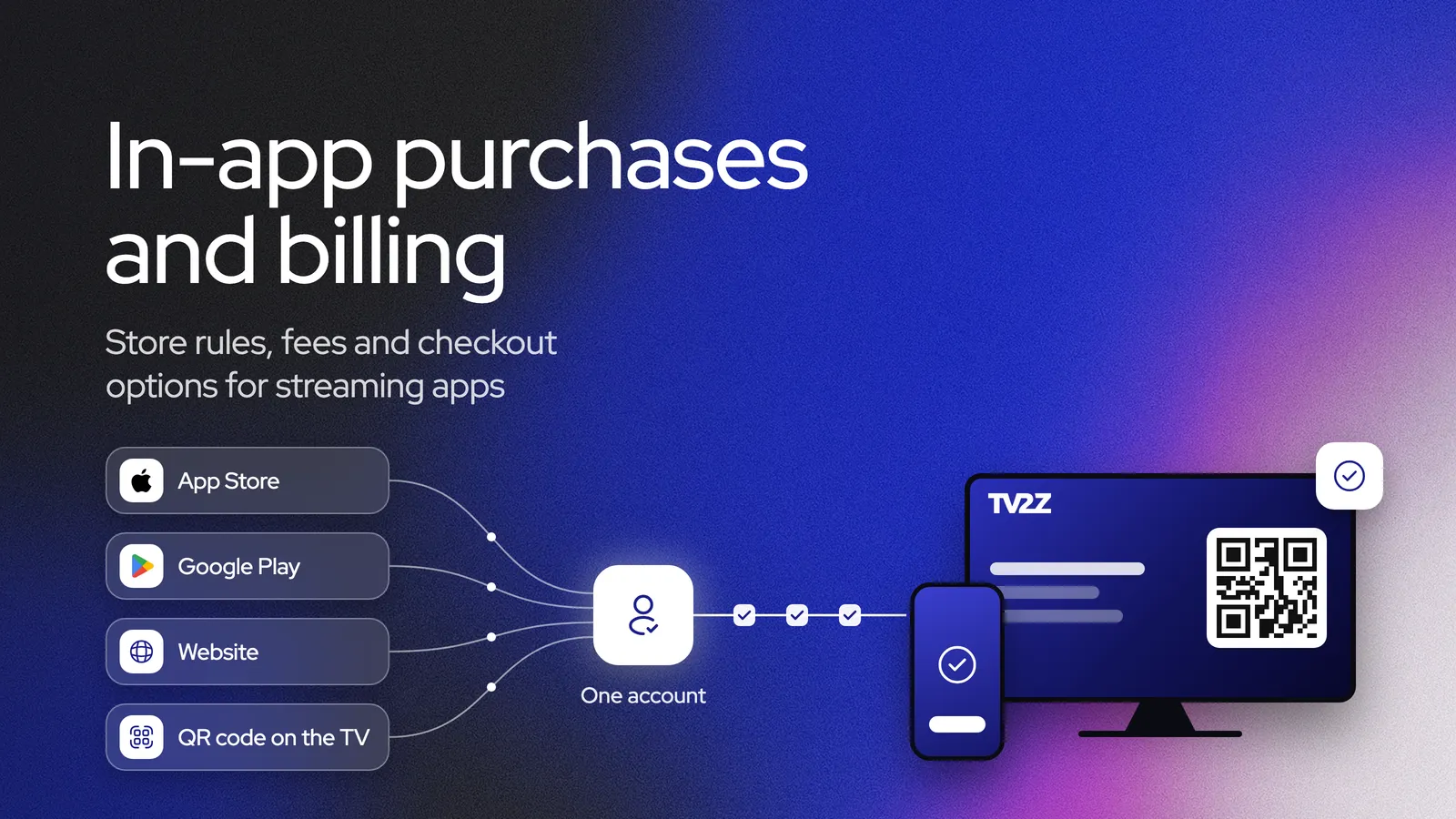
For paying, the choice is between the TV platform's billing and a QR code that sends the viewer to pay on their phone. A QR code moves the payment to the device that already has the card and the wallet. But it is only allowed where the platform permits it. Roku and Fire TV do not. Google TV allows links only in the EEA, where an app that links out cannot also sell through Google Play Billing. Apple TV allows them under the EU terms, which count a link that can be scanned as a link. In the US, Apple's rules on links name no platform, but the court order behind them is framed around iPhone and iPad, so confirm with App Review first. Elsewhere, Apple TV allows only the reader-app account link. Samsung and LG publish no clear rule, so the terms need agreeing with the platform first. And because the payment then happens on the service's own checkout, the rules in the next section apply to it.
The QR code is most at home on devices the operator controls, such as the set-top boxes in a managed TVaaS service or an operator's own Android TV box. There is no store in between, so the operator sets the rules, and the charge can go onto the bill the customer already pays.
Selling direct: the country rules beyond the stores
A service that sells on its own website, or through a QR code on the TV, steps outside the store's rules and into each country's own rules for subscriptions, tax and payments. On a store channel, the store handles much of this. On a direct channel, the service does: it needs a payment provider, a billing platform for subscriptions, tax registration, support for failed payments and disputes, and checkout flows that meet each country's consumer law.
Consumer law. Many countries now regulate how subscriptions are sold and, above all, how they are cancelled:
- EU. Consumers have 14 days to withdraw from an online contract. For streaming, the right can end once the viewer starts watching, but only with their express consent and acknowledgement, so the checkout needs to ask for both. Whether a subscription counts as digital content or a digital service changes what applies, which is worth checking with a lawyer. Since 19 June 2026, any online contract that carries a withdrawal right also needs a withdrawal button, with a two-step flow and a confirmation on a durable medium.
- Germany has required a cancellation button ("Verträge hier kündigen") on websites that sell subscriptions since July 2022, and after the first term a subscription can be cancelled at any time with at most a month's notice. France requires subscriptions sold online to be cancellable online in a few clicks. In the Netherlands, a subscription that renews automatically can be cancelled at any time after the first term, with at most a month's notice, and in the same way it was taken out.
- United Kingdom. New subscription rules under the DMCC Act are due to take effect on 1 January 2027, subject to Parliament: reminders before a trial ends and every six months, an easy way out, and new cooling-off periods.
- United States. The FTC's federal "click to cancel" rule was struck down in July 2025, and the FTC has started again. The federal baseline remains ROSCA: clear terms, express consent and a simple way to stop paying. States go further: California requires express affirmative consent to the renewal terms, an annual reminder and online cancellation for online sign-ups.
- Japan, Brazil and Australia. Japan requires a final confirmation screen that shows price, timing and cancellation terms before an online order. Brazil's consumer code gives a seven-day right to withdraw from online purchases. Australia passed a ban on unfair trading practices in July 2026, including easy cancellation for subscriptions, from July 2027.
Most of these rules apply to in-app subscriptions too, but there the store's own sign-up and cancellation flows carry much of the load. On the web, the service builds them itself.
Tax. When the store sells, it collects the VAT, GST or consumption tax. When the service sells direct, it usually has to register: in the EU once, for every member state, through the One-Stop Shop; in the UK from the first sale if it is not established there; for Korea's VAT and India's GST on online services; for Japan's consumption tax above its sales threshold; and in Australia above A$75,000 a year. Brazil's tax reform phases in new taxes on goods and services, digital services included, from a test year in 2026 to 2033, with new duties for foreign suppliers along the way, and in the US, sales tax on streaming depends on the state.
Payments. Cards are not the default everywhere, and recurring payments work differently by country:
- In the EU and the UK, the first card payment of a subscription needs strong customer authentication; renewals the merchant starts can usually go through without it.
- In India, recurring card and UPI payments run on e-mandates: the first payment needs extra authentication, later ones up to ₹15,000 run without it, and the bank notifies the customer at least 24 hours before each debit.
- In Brazil, Pix Automático has offered recurring payments by bank authorisation since June 2025.
- In the Netherlands, iDEAL is becoming Wero, and recurring payments typically run on SEPA direct debit after a first iDEAL payment.
- In Japan and South Korea, carrier billing and local wallets matter, and paying cash at a Japanese convenience store does not renew by itself.
Stores already support many of these methods for their own billing. A direct checkout has to add them market by market.
One subscription on every screen
Whatever the mix, each store knows only about purchases made in that store. Apple does not know that a viewer pays on the web; Roku does not know about the subscription on the viewer's iPhone. If every app asked only its own store, a viewer who subscribed on their phone would be asked to subscribe again on the TV.
The answer is an entitlement service: one record per account of who may watch what, until when, and where they paid. Every app asks that record, not its own store. Every store tells that record when something changes.
The stores provide the messages to keep it current:
- Apple sends signed App Store Server Notifications for every change in a subscription's life, and offers an API to look up a subscription's status and history. An app account token links each purchase to the service's own account ID.
- Google sends real-time developer notifications through Cloud Pub/Sub, and treats its subscriptions API as the source of truth. A new purchase must be acknowledged within three days, or Google refunds it.
- Web payment providers send webhooks, and Roku and Amazon have APIs of their own.
The messages are the easy part. The harder part is what the service does with them:
- Failed payments. Apple retries a failed renewal for up to 60 days and offers an optional grace period, of 3, 16 or 28 days for most plans, in which the viewer keeps watching. Google's grace period is on by default, followed by an account hold in which access stops. This window decides whether a failed payment becomes a lost subscriber.
- Refunds. Apple decides App Store refunds and can first ask the service how much the viewer watched. On Google Play, the developer issues most refunds itself, and Google issues some. Either way, access should stop on every screen when the refund arrives.
- Price changes. Apple asks subscribers to agree to large or repeated increases, and to any increase where local rules require it. Google asks for consent by default, and allows increases without it only in some countries and within limits. A viewer who does not agree loses the subscription at renewal, so a price rise needs planning store by store, and country by country, not one change on the web.
- Family sharing. Apple lets a family share a subscription, if the service turns it on. Google Play does not share third-party subscriptions.
- Plan changes. A subscription can only be upgraded or downgraded where it was bought, and is usually cancelled there too, although Google also lets the service cancel a Play subscription from its own systems. A viewer who pays through Apple cannot upgrade on the website, so every app needs to know where each subscription lives and send the viewer to the right place.
- Double payments. A viewer who forgets they already subscribed on one store can easily subscribe again on another. The entitlement service should catch it before the viewer pays twice.
Behind all of this sits a product catalogue: one plan, mapped to a product in each store, with prices set per country in each. Keeping that catalogue in one place, such as the content management system that runs the service, stops the stores drifting apart.
The figure below follows one subscription through its life: what each store reports at each step, and what every screen shows with and without one shared entitlement.

One subscription, every screen
Where the viewer pays
What happens next
What the service hears
The App Store confirms a new subscription.
What it does
Links the purchase to the viewer's account. With a shared entitlement, every screen they sign in on unlocks.
On each screen
- Phone(paid here)Watching
- Smart TVWatching
- BrowserWatching
- Set-top boxWatching
Choosing the mix
The right mix depends on the audience, the price and the country.
Store billing is usually the right path when the audience is mobile-first, when the price is low and the decision quick, when the service is entering countries where it has no local payment methods or tax registration, and on the TV platforms that require it. If the service qualifies for Apple's Video Partner Program or Small Business Program, the App Store's cost drops to 15% from the start. Outside the countries with their own terms, that is a real choice: the Video Partner Program requires In-App Purchase, and the reader-app link requires an app that sells nothing.
Direct billing, through the web or a QR code, makes more sense when the service already has a relationship with its viewers, when prices are higher or plans are annual, when subscriptions are sold through partners and bundles, and in countries where a link to the web is cheap, such as iPhone apps in the US for now. It also keeps the customer relationship: on a store channel the store holds the payment details, and the service sees only what the viewer shares with it. In return, it means taking on each country's consumer, tax and payment rules.
For a telecom operator or ISP, the cheapest checkout is often the bill the customer already pays. The TV service is sold and billed in the operator's own systems, and the apps on phones and retail TVs only need sign-in, except where a platform such as Roku requires its own billing. Google Play even lets telecom, broadband, cable and managed IPTV providers charge digital services to the customer's existing bill inside their own apps, for services they also sell outside mobile.
A third route is selling through a platform's own channel store, such as Prime Video Channels, Apple TV Channels or Roku's premium subscriptions, which added 30 new bundles in the US in September 2026. According to Antenna, about one in three new streaming subscriptions in the first quarter of 2025 came through such channel stores, mostly Amazon Channels. They can reach a large audience, but the viewer belongs to the platform, and a subscription sold there often stays inside the platform's app.
In practice, most services end up with a mix that differs by country: store billing where it is required, direct billing where it is allowed and worth it, sign-in on every screen, and one entitlement behind all of them. Vouchers and partner codes add another route, redeemed on the web and honoured everywhere, which matters for services sold through retailers or telcos, from niche OTT services to enterprise OTT platforms.
Once the mix is live, the useful measure is net revenue and churn by channel and by country. A store subscriber may cost more in commission and stay longer; a web subscriber may cost less and leave sooner. Only data broken down that way, in the service's own reporting or a business intelligence tool, shows which is which. Which revenue models to offer in the first place is covered in our article on advertising in OTT.
What changes next
The rules will keep moving. These are the dates to watch:
- 16 December 2026: the Australian court hears Apple's request to pause its orders.
- 31 December 2026: Google's new fee structure reaches South Korea, and Google plans to allow links to the web there.
- 1 January 2027: the UK's new subscription rules take effect, subject to Parliament.
- 11 January 2027: the US Supreme Court hears Apple's appeal against the contempt finding. A separate court is still to decide what Apple may charge on US links to the web.
- Early 2027: Apple and Google must allow payment links in South Korea, about three months after receiving the regulator's written orders.
- 1 March 2027: the Australian court orders against Apple take effect, unless stayed on appeal. Apple may ask to extend this to 3 May 2027.
- 1 July 2027: Australia's ban on unfair trading practices, including subscription cancellation, takes effect.
- By 30 September 2027: Google's new fee structure reaches the rest of the world.
- No date yet: the CMA's decision on steering in the UK.
Questions to ask before you launch
- On which platforms do you need to sell, and on which is sign-in enough?
- Which countries matter most, and what do the store rules allow in each today?
- Do you qualify for Apple's Video Partner Program or Small Business Program, and does that fit with how you want to sell?
- Where you sell direct, are you ready for each country's cancellation, tax and payment rules?
- Where does the entitlement live, and how quickly does a purchase on one screen unlock the others?
- How do you handle grace periods, billing retries, refunds and price increases in each store?
- Where can a viewer upgrade, downgrade or cancel, and does every app send them to the right place?
- How do you stop a viewer paying twice in two stores?
- Who sells to the viewer on each channel, and who handles tax?
- Can you see revenue and churn by channel and by country, not only in total?
- Who watches the rules, so that a change in one country reaches your checkout in time?
Where to start
Billing is easiest to get right when it is designed country by country and with the entitlement at the centre, rather than added one store at a time. The rules will keep moving, especially on phones, so the design that lasts is one where adding a checkout, opening a country or changing a price is a configuration change rather than a new project.
If you are planning a service across phones, TVs and the web and want to work out which mix of stores, web checkout and QR codes fits your audience and your markets, we are glad to think it through with you.